Why More Organizations are Turning to Full-Service Event Production Partners

At a Glance

A full-service event production partner brings together strategy, creative development, technical execution and operational oversight within one coordinated structure — an approach that’s becoming more relevant as corporate events grow in complexity.

As corporate events become more complex and experience-driven, organizations increasingly need a full-service event production partner capable of integrating strategy, creative development, technical execution and operational oversight within one coordinated structure.

A full-service event production partner helps reduce planning friction, improve communication and create more cohesive participant experiences across conferences, leadership meetings, hybrid programs and large-scale corporate events.

You’re Not Producing Yesterday’s Events Anymore

Corporate events have evolved far beyond scheduled gatherings on a calendar. Today, they function as extensions of:

  • brand strategy
  • leadership communication
  • audience engagement
  • immersive experience design

Audiences now expect the same level of polish, immediacy and emotional connection they experience across media, entertainment and digital platforms every day. That shift has fundamentally changed what event teams are being asked to manage.

For years, event production was viewed as a downstream function — something that happened after the strategy was finalized, the agenda was approved and the venue contract was signed. Production teams were expected to execute the plan, support the technology and make the environment functional once larger event decisions had already been made.

That distinction has started to disappear.

A leadership summit is no longer simply a room, a stage and a presentation schedule. A sales kickoff now carries the weight of internal culture-building, executive communication and audience engagement simultaneously. Conferences increasingly function as media experiences, networking environments and content platforms all at once.

At the same time, the operational complexity behind those experiences has expanded dramatically.

Modern event teams are often balancing:

  • hybrid participation
  • executive stakeholders
  • live streaming environments
  • scenic design
  • audience engagement technology
  • content capture
  • digital communications
  • compressed planning timelines

That complexity has reshaped what organizations need from an event partner. Rather than coordinating multiple disconnected vendors across staging, event technology, creative, digital engagement and logistics, many organizations are consolidating support through full-service event production partnerships that unify strategy, execution and operational oversight within one collaborative team.

The appeal isn’t simply efficiency, though efficiency certainly matters.

It’s the ability to create alignment across every part of the event experience while reducing the friction that often emerges when too many moving pieces are managed independently.

When planning, production and execution evolve together from the outset, events tend to feel more cohesive — not only for participants, but for the teams delivering them.
The Growing Complexity of Modern Events

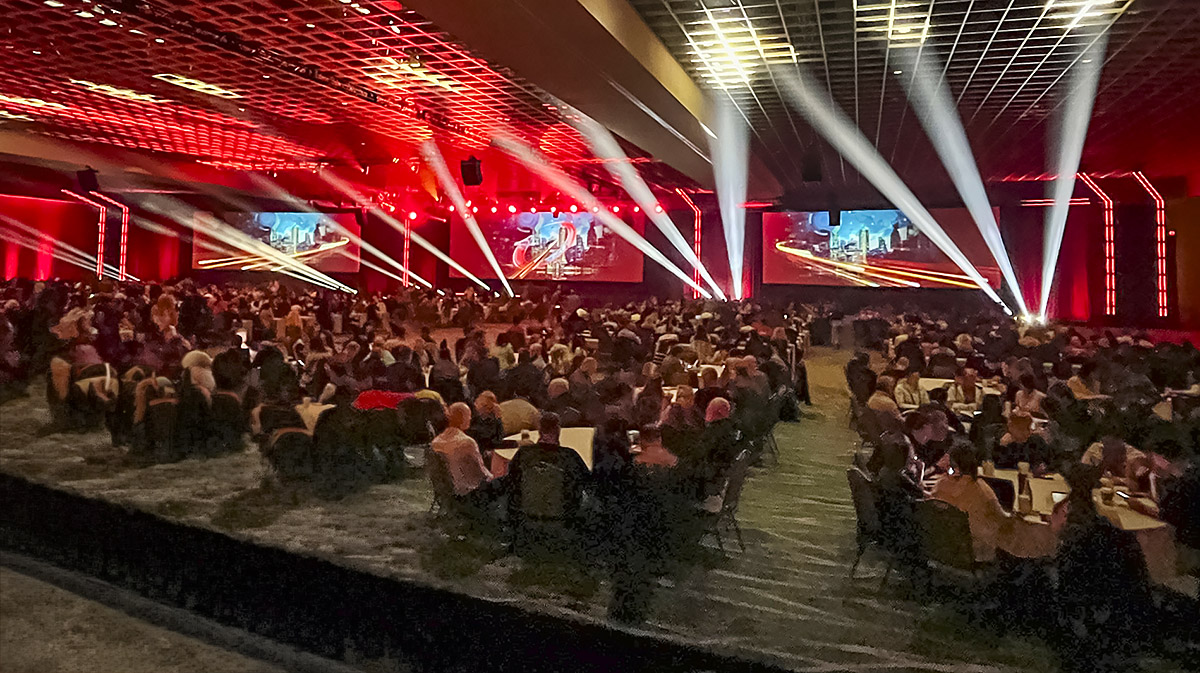
One of the most significant changes in the events industry over the last decade is that production complexity is no longer isolated to large-scale conferences or heavily theatrical experiences. Complexity now exists at nearly every level of corporate event planning.

A leadership meeting may involve simultaneous remote participation across multiple regions. An executive town hall might require broadcast-quality streaming alongside in-room audience engagement. A customer event may need to support live demonstrations, branded scenic environments, content capture and post-event distribution strategies all within the same production framework.

The challenge isn’t simply that events contain more elements than they once did. It’s that those elements have become increasingly interconnected.

A revision to presentation content can affect graphics workflows, lighting cues, show timing and streaming execution simultaneously. Changes to room layouts can influence audience movement, camera positioning and engagement visibility.

Small decisions now carry wider operational consequences because modern events function as integrated systems rather than isolated production tasks. For internal teams, that interconnectedness creates a different kind of planning pressure than they experienced in the past.

Event leaders are expected to move quickly while balancing:

  • executive expectations
  • participant experience goals
  • budget realities
  • compressed timelines
  • rising expectations around execution quality

At the same time, they’re coordinating stakeholders across:

  • marketing
  • communications
  • operations
  • leadership
  • external production partners

In that environment, fragmented planning structures become increasingly difficult to sustain.

This shift is one reason centralized production models have gained momentum across the corporate events landscape. The goal isn’t just to simplify logistics. It’s to create greater continuity between the strategic goals of the event and the operational systems responsible for bringing those goals to life.

How Centralized Event Production Improves Coordination

Centralized event production improves coordination by aligning planning, communication and execution within a single team structure.

One of the less visible realities of event planning is how much energy organizations spend managing coordination itself.

When multiple agencies, technical providers, venues and internal teams all operate independently, communication can become fragmented in ways that are difficult to recognize until pressure builds closer to showtime:

  • information passes through too many hands
  • timelines evolve unevenly
  • small misunderstandings compound

These miscues hide in the background until something that would have been easy to fix early on surfaces as a production issue late in the process. None of this necessarily reflects poor performance from individual partners. In many cases, every vendor involved is highly capable within their own area of expertise. The challenge is structural.

Disconnected ownership makes it harder to maintain alignment. Teams become reactive because no single group maintains visibility across the broader event ecosystem.

Centralized Production Creates Operational Clarity

A centralized production structure changes that dynamic by creating one coordinated operational framework for planning and execution. Instead of functioning as separate workstreams that occasionally intersect, creative development, technical planning and production management operate together from the beginning.

What a Full-Service Event Production Partner Actually Manages

The term “full-service event production” is often used broadly, but truly integrated support typically reaches far beyond equipment and staging.

A comprehensive production partner may support:

  • event strategy and creative development
  • production management and show coordination
  • event technology solutions
  • scenic fabrication and branded environments
  • audience engagement technology
  • digital signage and event communications
  • on-site technical execution
  • presenter support and rehearsal management
  • hybrid event production
  • post-event reporting and measurement

The advantage of this structure isn’t simply having access to more services. It’s having those capabilities coordinated through one unified production team.

That alignment allows creative ideas, technical planning and operational execution to support one another from the earliest planning stages through final delivery.

As events become more experiential, organizations are also placing greater emphasis on consistency across every participant touchpoint. Messaging, visuals, staging, technology and production quality all contribute to how audiences perceive the event experience as a whole.

When those elements are developed independently, experiences can feel fragmented. Integrated production planning helps create stronger continuity throughout the participant journey.

Why Creative Strategy and Technical Production Work Best Together

There was a time when technical production was treated as a support function operating behind the scenes while creative strategy existed independently at the front of the experience.

That distinction no longer reflects how modern events actually function.

Today, production decisions directly shape audience engagement, content retention and emotional response. Lighting influences energy and focus. Scenic environments influence perception and immersion. Camera direction affects how hybrid audiences connect with presenters. Room design changes how participants interact with one another and with the content itself.

Technical Execution Has Become Part of the Storytelling

Organizations increasingly benefit from production teams that are involved early enough to contribute strategically rather than simply execute pre-defined requirements.

When technical experts, creative strategists and event stakeholders collaborate from the beginning, events gain flexibility. Creative concepts can be developed with production realities in mind instead of being retrofitted later under deadline pressure. Technical planning becomes more proactive. Audience experience decisions become more intentional.

The resulting experiences aren’t necessarily larger or more elaborate. In many cases, they’re simply more cohesive.

This shift also reflects broader changes in audience expectations — participants increasingly compare corporate events to the polished experiences they encounter across entertainment, media and digital platforms. Production quality is no longer perceived separately from content quality. The audience experiences them as part of a single environment.

That expectation has raised the importance of integrated production thinking across nearly every type of event experience.

The Operational Advantage of a Dedicated Event Producer

A dedicated event producer creates continuity across planning by serving as a centralized operational lead responsible for maintaining alignment throughout the event lifecycle.

One of the most understated advantages of a full-service production partnership is the role of dedicated production leadership.

For internal event teams, planning cycles are rarely isolated from broader organizational responsibilities. The same stakeholders managing a conference or leadership event are often balancing communications initiatives, executive coordination, marketing priorities and operational demands simultaneously.

A dedicated event producer helps create continuity across that complexity.

Rather than requiring teams to coordinate separately with venues, technical providers, creative partners and production crews, the producer becomes a centralized operational lead responsible for maintaining alignment throughout the process.

They help manage timelines, oversee communication, anticipate production challenges and maintain momentum as priorities evolve. The producer role becomes particularly valuable during periods of uncertainty or change, which are increasingly common in event environments where:

  • presenters revise content late in the process
  • stakeholder priorities shift
  • room configurations evolve
  • technical requirements change unexpectedly

Under those conditions, operational continuity matters just as much as technical capability.

A strong production lead helps absorb that volatility before it affects the participant experience itself.

More importantly, dedicated production leadership creates confidence for internal teams. It gives organizations the sense that someone is actively overseeing the broader event ecosystem rather than simply managing isolated production tasks.

That confidence is difficult to quantify, but it often becomes one of the defining characteristics of a successful event partnership.

Building Better Event Experiences Through Integrated Technology

Integrated technology improves the event experience when it supports engagement naturally and works in step with the broader production strategy.

Technology now shapes nearly every stage of the event experience, but organizations are becoming increasingly aware that technology alone doesn’t create engagement.

Over the last several years, many event environments have accumulated layers of platforms, applications, audience engagement tools, communication systems and hybrid event technologies intended to improve participation and streamline communication.

In practice, however, disconnected technology can create as much friction as value when it’s introduced without a clear relationship to the broader participant experience.

The Best Event Technology Often Feels Invisible

The most effective event technology strategies tend to feel almost invisible to participants because the tools themselves support the experience naturally rather than competing for attention. That level of integration requires coordination from the earliest stages of development across strategy, production and technical planning.

When systems are thoughtfully aligned, technology becomes less about features and more about facilitating connections. As a result:

  • hybrid audiences feel more included
  • presenters interact more naturally with participants
  • communication becomes more intuitive
  • audience participation feels embedded into the event

As hybrid and multi-format experiences continue evolving, organizations increasingly need production environments capable of supporting both operational efficiency and meaningful engagement simultaneously.

Reducing Event Risk Through End-to-End Production Support

End-to-end production support reduces event risk by creating continuity across planning, execution and post-event coordination.

Every event contains some degree of unpredictability. Timelines shift. Executive priorities evolve. Presenters revise content late in the process. Technical issues emerge without warning.

The focus shouldn’t be on eliminating uncertainty. That’s impossible. It should be on building systems that can adapt without compromising the participant experience. End-to-end production support helps create adaptability by maintaining continuity across planning, execution and post-event coordination.

When one coordinated team oversees the broader production environment, potential issues are identified earlier, communication pathways become clearer and teams can make faster adjustments without losing visibility across the full event ecosystem.

This is especially important for multi-day conferences, executive meetings, hybrid programs and customer-facing events, where even minor changes can affect multiple systems at once.

In those moments, responsiveness matters as much as technical expertise.

The most effective production teams aren’t simply executing predetermined plans. They’re adapting in real time while protecting the integrity of the participant experience. From the audience’s perspective, successful production often appears effortless. Behind the scenes, that stability is usually the result of coordinated systems designed to absorb complexity before it becomes visible.

Choosing an Event Production Partner That Can Scale With Your Goals

As organizations evaluate production partnerships today, the conversation is increasingly shifting beyond technical inventories or standalone capabilities.

Many event leaders are looking for partners capable of functioning as genuine extensions of their internal teams — collaborators who understand not only production logistics, but also audience dynamics, executive communication, operational realities and the broader goals driving the event itself.

That distinction matters more as events continue evolving into multi-dimensional audience experiences shaped by storytelling, technology, engagement and brand perception simultaneously.

The strongest partnerships are rarely built solely around equipment or execution. They’re built around trust, communication and shared ownership of outcomes. When production teams are integrated early enough to contribute strategically, organizations gain more than technical support. They gain operational flexibility, creative collaboration and a clearer path through the growing complexity surrounding modern events.

Increasingly, that clarity is what allows organizations to focus less on managing logistics and more on creating experiences that genuinely resonate with the people in the room.

Key Takeaways

Centralized production structures improve execution consistency: Integrated production models create stronger communication, operational visibility and alignment across creative, technical and strategic workflows.

Modern events require interconnected planning: Creative strategy, audience experience and technical execution now influence one another continuously throughout the event lifecycle.

Dedicated production leadership reduces operational friction: A centralized production lead helps teams navigate shifting priorities, technical dependencies and stakeholder coordination more effectively.

Event technology works best when integrated intentionally: Audience engagement tools create stronger experiences when they support — rather than compete with — the broader participant environment.

Full-service production partnerships help organizations focus on audience impact: By reducing coordination complexity, organizations can spend less time managing logistics and more time creating meaningful participant experiences.

Common Questions About Full-Service Event Production

A full-service event production partner manages the strategic, technical and operational aspects of an event, including planning, event technology, scenic design, audience engagement technology, hybrid support and on-site coordination.

Organizations increasingly consolidate event production support to simplify coordination, improve communication and create more cohesive experiences across creative, technical and logistical workflows.

Corporate event production services may include event strategy, show production, event technology support, lighting, scenic fabrication, digital engagement tools, hybrid streaming and live technical execution.

A dedicated event producer centralizes communication, coordinates timelines, manages stakeholders and helps teams respond more effectively to evolving production needs throughout the planning process.

Integrated event technology improves participant engagement, supports hybrid participation and helps create more connected experiences across digital and in-person audiences.

Conferences, leadership meetings, hybrid events, customer experiences, executive programs, galas and multi-day corporate events often benefit from centralized production planning and execution support.

Ready to get started?

Explore how full-service event production simplifies planning.